

Geodesic Dome Are The Triangles The Same Size?
In order to build the 3D simulation program for the dome, I had to effigy out what the construction of our dome really is. I'd like to share what I learned about geodesic domes.
Motivation
Everyone at Burning Man has a geodesic dome. Okay, not everyone has i, but it certain seems like that. (I accept ane of those impaired vi-postal service Sears awning thingies.) There are lots of domes of different sizes and degree. The geodesic dome construction is dictated by some geometry and some math. Here'south an image I've rendered of a geodesic "five/viii 3v" dome. (I'll explain what "five/eight" and "3v" mean subsequently.)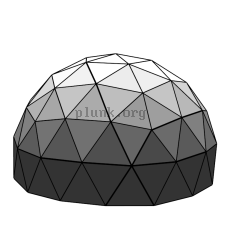
A "geodesic" dome
The invention of the geodesic dome is credited to Buckminster Fuller but is reported to take been invented 25 years earlier by Walter Bauerfeld for work on a planetarium projector at Carl Zeiss optics.
Geodesic Dome Geometry
Geodesic domes don't have i canonical grade, only the near pop is based on an icosahedron whose triangular faces are so subdivided into smaller triangles. An icosahedron has xx faces, each of which is an equilateral triangle and therefore all of the triangles are the same size. Every bit y'all tin can see in the movie below, an icosahedron appears to have a cap and then a base made up of five triangles all sharing the peak and bottom points, respectively. X triangles connect the cap and base. Wikipedia has a quite extensive and bewildering page about icosahedra.
In case you want it, hither'southward a text file of the corners, edges, and triangles that brand upwards an icosahedron.
Triangles are structurally very strong. If you lean on 1 of the corners of a triangle made from three pipes bolted together, the just manner it can plummet is if ane of the pipes actually buckles or if a nut completely shears off of a bolt. Information technology's much stronger than a rectangle; a rectangle of pipes and bolts could plummet if the bolts slip, which is much more probable than a shear. The canopy thingy I bought from Sears actually can't stand up up to the wind because it's all rectangles. (Cross-caryatid ropes helped somewhat in 2004 and 2005, but increased the stress on the struts.)
The force put into a corner of a triangle is straight transmitted to the base of the triangle. Since an icosahedron is made up of triangles, the strength is distributed throughout the shape. The icosahedron tin can plummet from one of the joints between dissever triangles bending, but that's yet a very stiff construction.
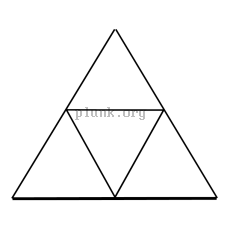
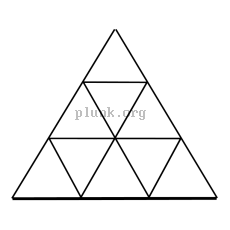
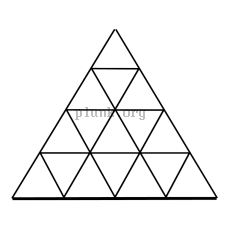
To make an icosahedron approximate a sphere more closely, the triangles making up the icosahedron are subdivided by splitting the edges of the triangle and so making the new split edges into more than triangles. Equally in the pictures below, splitting each border into northward new edges yields n2 new triangles.
 |  |  | ||
| | | |
The popular notation on the web for this seems to be mV, where grand is the number of new edges made from each original border, similar 2v, 3v, 4v, etc...
If the corners of the new triangles are and then moved out to the surface of a sphere centered on the icosahedron, you get something that looks more and more than similar a sphere the more the triangles are divide. These are called "geodesic spheres". Here are geodesic spheres where the initial edges are split into ii edges (resulting in fourscore triangles), 3 edges (180 new triangles), and iv edges (320 new triangles). I've thrown in one with 10 new edges from each initial edge, yielding 2000 triangles, 100 for each original triangle on the icosahedron.
To make a geodesic dome, you cut a geodesic sphere in one-half.
Spheres with an odd degree (1v, 3v, 5v, etc...) can't actually be cut exactly in half. There'south a ring of triangles that span the eye of the sphere, so typically you lot choose to carve up either just above or below that band. For 3v domes, the popular name on the web for splitting in a higher place or below the ring seems to be "3/8" and "5/8", respectively. Here are pictures of 2v, 3/eight 3v, five/eight 3v, 4v, and 10v geodesic domes.
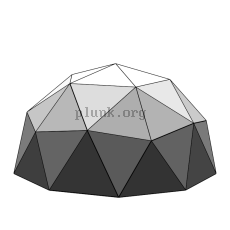 | 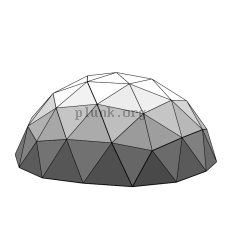 | | ||
| | | |
(I'thousand not really sure why the two variants of the 3v domes are called "3/eight" and "5/8". In that location are 9 edges in a zig-zag from the tiptop of a 3v sphere to the bottom, so it seems to me like "iv/9" and "5/9" would be better names.)
Really Edifice a Dome
One interesting thing about the process of splitting the triangles then moving ("projecting") the corners out to the surface of a sphere is that the edges change then they are no longer equal lengths. Thus the triangles are no longer equilateral. The math is a little complicated to get right. (I wrote a program to practise it.) I've provided a picture beneath of a single 3v triangle earlier and after projecting onto the sphere, including the new lengths if the original triangle was 3 meters on each side. 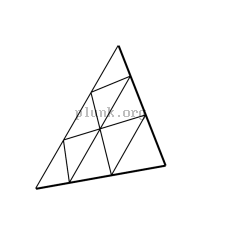 | 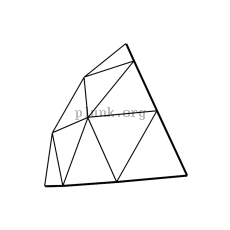 | 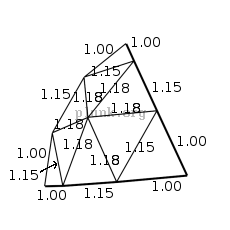 | ||
| | | |
This is why sites like Desert Domes are and then useful to dome builders; the Desert Domes site provides the ratios of strut lengths for domes of the most common degrees.
You can see that there are only three unique lengths; one.00, one.15, and 1.eighteen meters. One way to provide an easy template for building such a dome is to colour lawmaking the struts, and provide a diagram of how the concluding dome looks with colored struts. For example, let's color the ane.18-meter struts light-green, the 1.15-meter struts orange, and the ane-meter struts bluish.
Equally an aside, if you were to brand a "5/eight" 3v dome with struts of 1, one.15, and ane.18 meters, the dome would be five.7 meters across. (well-nigh 19 feet)
Our domes at Burning Man were v/viii 3v domes. I've prepared a text file with the geometry of a 5/eight 3v dome , in case you lot want information technology. Here are a pair of images showing those kind of domes with color-keyed struts.
One way to construct a dome is to cutting lengths of pipe (steel pipe or electric conduit if force is less of import), crimp the ends, drill holes through the ends, and so bolt all the pipes together at the dome corners. This seems to be very popular, probably because it'southward easy. The pipes can also be bolted to plates that form the corners of the dome, merely this takes a little more than work and is slightly less stable with just 1 pigsty in each end of each pipage.
Here's a picture of the Karma Chickens' dome at Burning Man 2006, made from bolted-together electric conduit, with dome coverings on it and a little storage quonset attached to information technology. I don't take any credit for this dome; it and some other just like it were designed long before I joined the Karma Chickens' camp. At least this twelvemonth I did help raise the domes on the playa.
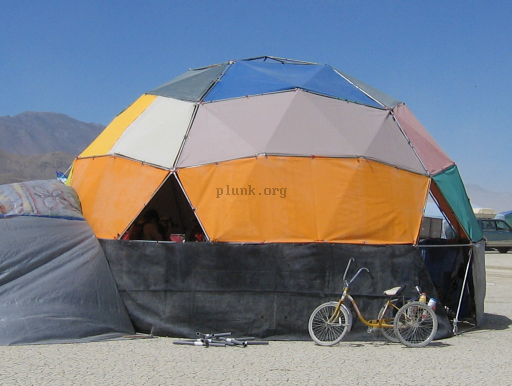
(We didn't finish the lighting project. Mayhap side by side twelvemonth I'll have pictures of that.)
Terminal modified:
Sun October 1 12:25:57 PDT 2006

Geodesic Dome Are The Triangles The Same Size?,
Source: https://www.plunk.org/~grantham/public/geodesic_domes/geodesic_domes.html
Posted by: marineyoune1946.blogspot.com
0 Response to "Geodesic Dome Are The Triangles The Same Size?"
Post a Comment